

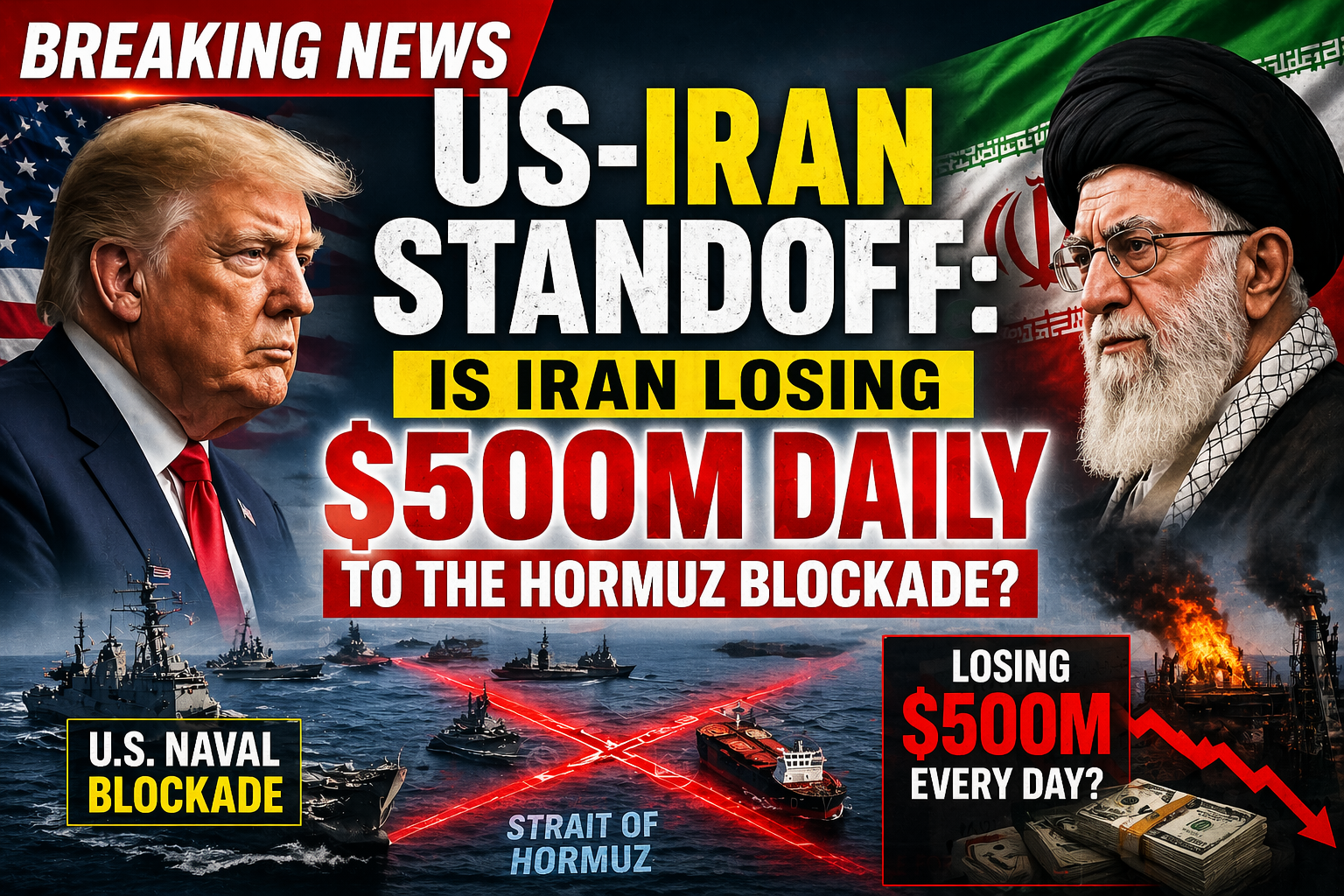
US-Iran Standoff
Tensions between the united states and Iran are heating up again – and this time, the war of the words is just as intense as the situation on the ground.
US President Donald Trump recently claimed that Iran is “collapsing financially”, alleging the country is losing up to $500 million every single day due to a US-led maritime blockade.But Iran isn’t buying that narrative. Officials in Tehran have quickly dismissed the claims as propaganda, calling it a “ploy” designed to pressure them in going ,fragile negotiations.
At the heart of this standoff is the strait of Hormuz – a narrow but crucial passage through which nearly one-fifth of the world’s flows. What happens here doesn’t just affect the US and Iran; it sends ripples across the entire global economy.
A battle of narratives:-
Trumps’s message has been clear and consistent: Iran is under severe economic strain. Posting on his Platform,he described the country as “starving for cash” and blamed the blockade for crippling its Oil revenues.
He also suggested that Iran’s tough public stance doesn’t reflect reality. according to him, Tehran actually wants the strain of Hormuz reopened as soon as possible but is trying to maintain a strong image.
‘Iran doesn’t want the strain closed; they wants it open so they can make $500million a day.’: Trump said,even claiming that financial pressure is affecting payments to Iran’s military and police forces.
For Trump,the message is strategic. By highlighting Iran’s alleged economic struggles, he’s reinforcing the idea that US Pressure is working -and that Tehran should come to the negotiating table on washington’s terms.
Iran’s fires back:-
Iranian officials, however, see things very differently.Figures like Mahdi Mohammadi have rejected Trumps’s statements outright,calling them ‘meaningless’ and politically motivated. from Tehran’s perspective,the blockade isn’t just economic pressure -it’s a form of aggression.
“The losing side cannot dictate terms,”Mohammadi said,pushing back against the idea that Iran is negotiating from a position of weakness.
Iran also denies that it is desperate to reopen the strain of a Hormuz. instead,its leaders argue that any such move must come with guarantees -like the lifting of US restrictions and respect for its sovereignty.
In short,both sides are telling very different stories -and neither seems willing to budget.
Why the strait of Hormuz matter so much?
To understand why this crisis is so serious, you have to look at the map.
The strain of Hormuz connects the persian Gulf of the Arabian Sea, and it’s one of the most important energy chokepoints in the world.Millions of barrels of Oil pass through it every day.thats why even small disruptions here can have outsizes consequences.The current standoff has already slowed shipping activity,pushed oil prices upward,and created uncertainty in global markets.
Iran has responded to the blackade with its own aggressive moves.including seizing cargo ships and warning that the strait cannot operate mormally under pressure.Meanwhile,the US continues to maintain a strong naval presence in the region.
It is a tense, crowded space -and that makes the risk of miscaculation vary real.
Talk going nowhere:-
despite a nominal ceasefire annpunced by the US, progress toward a real agreement has been painfully slow.Trump has extended the ceasefire to give diplomacy more time,but the gap between the two sides remains wide. Iran insists the US must ease its blockade before serious talks can begins.The US,on the other hand,wants clearer commitments from Iran first.Efforts by the countries,including mediation attempts,haven’t made much headway either.
Right now, negotiations feel stuck- less like a dialogue and more like a writing game,with each side hoping the other will blinkfirst.
The reality behind the numbers:
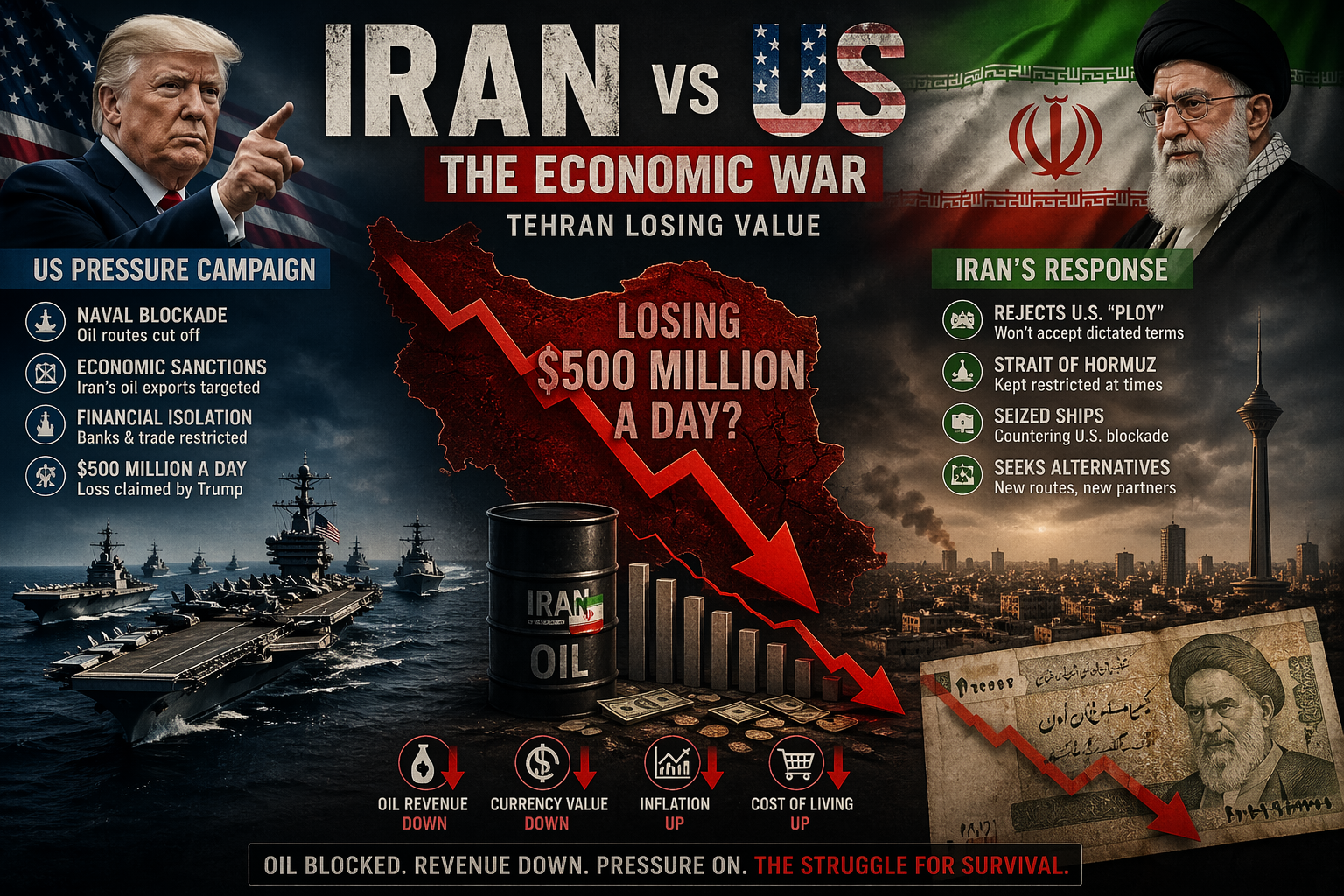
Trump’s claim that Iran is losing $500 Million a day has grabbed headline,but it’sindependetly verify.Iran has been under sanctions for years and has adapted in various ways, including finding alternative channels is undoubedtedly putting pressure on its economy.
these are reports of job losses,financial instability,and broader economic strain inside the country.still,Iranian officials argue that the US is exaggerating the situation to make its strategy look more effective than it really is.this isn’t just a conflict over territory or trade – it’s also a battle over preception.
why the world is watching closely :
The impact of this standoff goes far beyond Washington and Tehran.When oil flows through the strain of Hormuz are disruption,the effects are felt globally.Countries that rely heavily on imported energy -especially in Asia- are already seeing rising costs.European economies,too,are beginning to feel the pressure.
If the situation drags on, it could slow economic growth,strain supply chain, and increase inflation worldwide.That’s why these’s growing urgency for diplomatic solution, the longer this continues, the higher the stakes becomes – not just for the region.but for the entire global economy.
what happens next?
Right now, neither side appears ready to back down.Trump’s has made it clear that the blockade will stay in place untill Iran agrees to US conditions. Iran, meanwhile,insists it won’t negotiate under pressure.That leaves the situation in a delicate balance.with military forces operating in close quarters and tentions running high,even a small incident could escalate quickly.for now,it’s a standoff -one shaped as much by rhetoric as by reality.
Whether this crisis moves toward resolution or spirals in into something bigger may depend on one simple but diifficult question: are Washington and Tehran willing to compromise?
At moment, that still seems like a long shot.