


The tragic death of Twisha Sharma has shaken people across India and triggered emotional conversations about women’s safety, mental harassment, dowry-related abuse, and thee pressure many women silently face after marriage.
Death That Sparked Nationwide Debate on Women’s Safety:
What initially appeared to be another disturbing family tragedy quickly turned into a high-profile case involving allegations of domestic abuse, investigation controversies, viral social media debated and demands for justice.
As details continue to emerge, the Twisha Sharma case has become one of the most discussed stories online, with thousands of people expressing anger, sadness and concern.
Who Was Twisha Sharma?
Twisha Sharma was a 33-years-old woman originally from Noida. Reports describe her as educated, ambitious and professionally accomplished.
She reportedly held as MBA degree, worked in marketing and communications and had also participated in beauty pageants, including Miss Pune competitions. Some reports also mentioned her connection with the entertainment and modeling industry.
Twisha married Bhopal-based advocate Samarth Singh in December 2025.
According to reports, the couple met through a dating app before getting married. However, within just a few months of marriage, the relationship allegedly became deeply troubled.
What Happened in the Twisha Sharma Case?
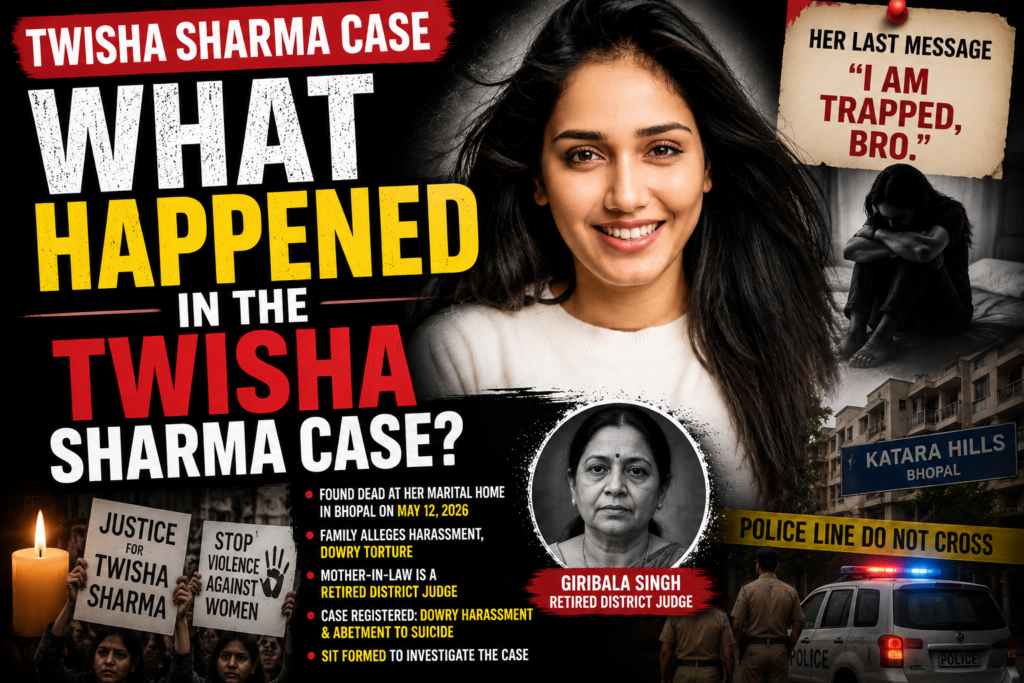
Twisha Sharma was found dead at her marital home in Bhopal’s Katara Hills area on May 12, 2026.
The case immediately attracted attention because her family alleged harassment, emotional abuse and dowry-related torture by her husband and mother-in-law.
Her mother-in-law, Giribala singh, is a retired district judge, which further increased public scrutiny around the investigation.
Police later registered a case related to dowry harassment and abetment to suicide while forming a special investigation Team(SIT) to investigate the matter.
The incident became even more emotional after reports surfaced about Twisha Sharma’s alleged final message to friends and family.
One widely discussed message reportedly said:
“I am trapped, bro.”
That sentence alone deeply affected many people online because it reflected fear, helplessness and emotional distress.
CCTV Footage Added More Questions.

The case took another dramatic turn after CCTV footage reportedly surfaced showing Twisha walking alone towards the terrace the terrace before she was later found unconscious.
The footage quickly spread across social media platforms and news channels.
Some people believed the CCTV supported the suicide theory, while others argued that the footage did not answer larger questions surrounding her condition, injuries and alleged harassment.
Police officials stated that the investigation initially pointed toward suicide rather than murder. However, Twisha’s family strongly questioned that conclusion and demanded a deeper investigation.
Allegations of Dowry Harassment and Mental Abuse.
One of the biggest reasons the case gained national attention is because it revived conversations around dowry harassment and emotional abuse within marriages.
Twisha’s family alleged that she faced severe mental pressure after marriage.
The case also raised uncomfortable questions about how emotional abuse often remains hidden closed doors.
In many Indian households, women hesitate to openly discuss harassment because of:
- Social pressure
- Fear of judgment
- Family expectations
- Financial dependence
- Emotional manipulation
- Concern about public reputation
Many people online connected emotionally with Twisha’s reported message because they reflected struggles that countless women silently experience.
The hashtag ” Justice for Twisha Sharma” soon began trending across social media platforms.
Investigation Controversies Increased Public Anger.
The investigation itself became controversial after reports claims that certain evidence handling procedures raised questions.
One major issue involved the belt allegedly used in the hanging incident.
According to reports, the investigating officer allegedly failed to present the belt during the post-mortem examination, creating doubts about handling.
Twisha’s family also demanded a second autopsy and raised concerns regarding injury marks reportedly found on her body.
Meanwhile, police maintained that the investigation was ongoing and that all evidence was being examined carefully.
As public pressure increased, the National Commission for Women (NCW) also sought a detailed report regarding the case.
Social Media Reactions Became Emotional:
The Twisha sharma case triggered massive reactions online.
Thousands of users shared emotional posts, demanding justice and transparency.
Some users highlighted how difficult it can be for women to seek help in abusive marriages.
Others questioned whether influential individuals receive special treatment during investigations.
At the same time, some people urged caution and requested that the investigation be allowed to proceed fairly before conclusions are drawn.
This division created intense online debates.
Many users compared the case to previous dowry-related deaths and domestic abuse incidents that shocked the country.
The emotional intensity surrounding the case shows how deeply society is affected whenever a young woman dies under suspicious circumstances shortly after marriage.
The Broader Problem of Dowry and Domestic Pressure:
Although India has strict laws against dowry, dowry-related harassment cases continue to emerge across the country.
In many situations, emotional pressure becomes difficult to prove legally because it happens privately within families.
Women facing abuse may appear normal publicly while suffering silently inside their homes.
The Twisha sharma case reopened discussions about:
- Women’s mental health after marriage
- Emotional abuse inside families
- Pressure placed on daughters-in-law
- Need for stronger support systems
- Importance of early intervention
- Failures in addressing domestic violence quickly
many activists and social media users argued that society often ignores warning signs until tragedy occurs.
Conflicting Claims Continue:
As the investigation continues, conflicting narratives from both sides have emerged publicly.
Twisha’s family alleges harassment and abuse, while the accused side has reportedly denied wrongdoing and presented its own version of events.
Because the matter remains under investigation, many important questions are still unanswered.
Authorities continue examining:
- CCTV footage
- Electronic evidence
- Call records
- Medical findings
- Statements from both families
Both sides have reportedly approached that court regarding preservation and scrutiny of digital evidence.
This means the final legal outcomes may depend heavily on forensic analysis and evidence review.
Why the Twisha Sharma Case Resonated Across India:
The case became viral not only because of the shocking circumstances bit also because many people saw it as a reflection of larger social problems.
The story connected emotionally with the public because it involved:
- A young educated woman
- Marriage-related pressure
- Allegations of harassment
- Mental trauma
- Questions about justice
- Public distrust in investigations
People across India continue discussing the case because it feels painfully relatable to larger concerns surrounding women’s safety.
Conclusion:
The Twisha Sharma case is far more than just another viral news story.
It has becomes a powerful remainder of how emotional suffering, domestic pressure and unanswered cries for help can sometimes remains invisible until tragedy occurs.
As investigators continue examining evidence, the country watches closely, hoping that the truth emerges through a fair and transparent process.
At the same time, the case has reignited urgent conversations about women’s mental health, domestic abuse, dowry harassment and the need for stronger emotional and legal support systems.
Regardless of the final legal outcome, the tragedy has already left a deep emotional impact on millions of people.
For many, Twisha sharma’s story represents not just one women’s struggle ,but the silent pain that countless women may still be carrying behind closed doors.
And that is why the demand for justice, accountability and societal change continues growing every single day.
1 thought on “Death That Sparked Nationwide Debate on Women’s Safety”