


Madhya Pradesh High Court Awards 10 Lakh to Businessman Wrongfully Jailed After Spices Were Mistaken for Drugs:
Imagine being arrested at an airport because officials believed the spices in your luggage were illegal drugs.
That nightmare became reality for a businessman in Madhya Pradesh, who spent 57 days in jail after airport security scanners reportedly mistook packets of garam masala and aamchur powder for heroin and psychotropic substances.
“57 Days in Jail for Carrying Spices: Madhya Pradesh High Court Awards Businessman 10 Lakh”
Now, after a pinful legal fight that lasted nearly 16 years, the Madhya Pradesh High Court has ordered the state government to pay him 10 lakh in compensation, calling the prolonged detention a violation of his fundamental rights.
The judgment has drawn national attention, not only because of the shocjing mix-up but also because it raises serious questions about forensic delayas, airport security procedures, and the human cost of wrongful arrests.
A Routine Airport Check Turned Into a Life-Changing Ordeal:
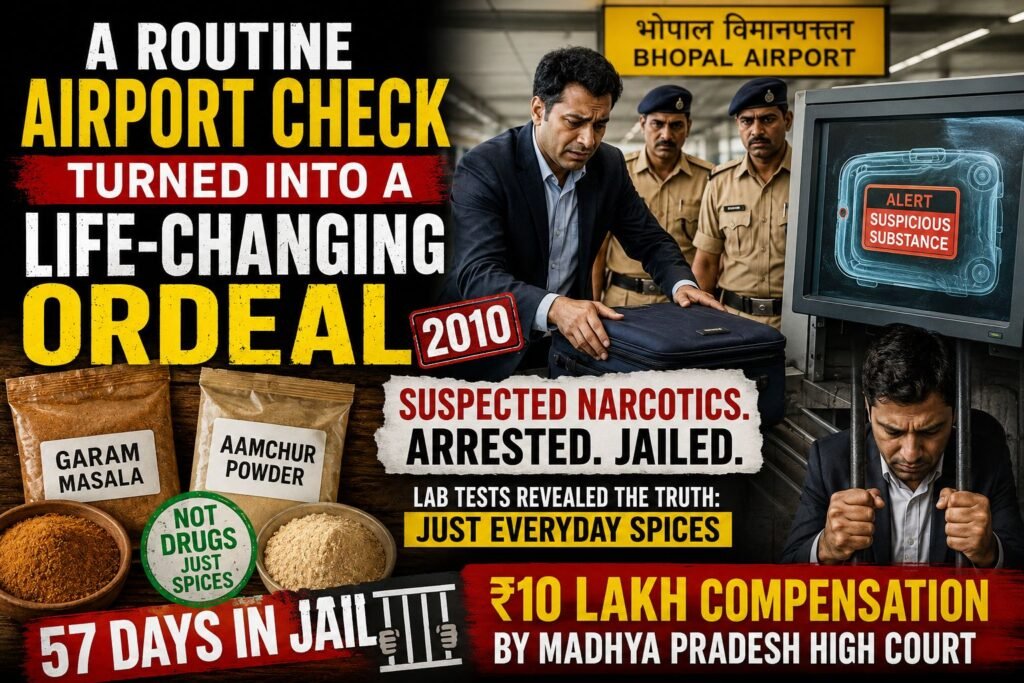
Back in 2010, the businessman was traveling through Bhopal airport carrying packets of common kitchen spices in his luggage.
During the security screening process, airport detection machines reportedly flagged the powders as suspicious substances. Authorities suspected the packets contained narcotics, including heroin and psychotropic drugs.
What should have been a simple verification process quickly escalated into a criminal case.
Despite there being no immediate forensic confirmation, the businessman was arrested under strict narcotics laws and sent to jail.
Later laboratory tests would reveal the truth: the so-called “suspicious substances” were nothing more than everyday spices-garam masala and aamchur powder.
But by then, nearly two months of his lige had already been lost behind bars.
57 Days in Jail for Carrying Spices:

One of the most heartbreaking parts of this case is the amount of time the businessman spent in custody waiting for forensic results.
For 57 days, he remained in jail while tests were conducted to determine whether the powders were actually illegal substsnces.
Eventually, the forensic reports confirmed that the materials were harmless cooking ingredients.
The court later questioned why the investigation and testing process took so long and why a person’s freedom was taken away before scientific evidence was properly verified.
For any innocent person, such an experinece can be devastating.
Beyond the physical confinement, wrongful imprisonment often brings:
- Mental stress
- Social humiliation
- Damage to reputation
- Financial losses
- Emotional trauma for families
Even after release, the stigma of being accused in a narcotics case can linger for years.
High Court Says Personal Liberty Was Violated:

While delivering its judgment, the Madhya Predesh High Court strongly emphasized the importance of personal liberty under Article 21 of the Indian Constitution.
The couer observed that no individual should suffer prolonged imprisonment simply because authorities failed to complete forensic procedures on time.
According to the judgment, the businessman’s constitutional right to life and liberty was violated due to:
- Delayed forensic examination
- Procedural inefficiency
- Unjustified prolonged detention
The court also stressed that investigative agencies have a responsibility to ensure that innocent citizens are not punished because of administrative lapses.
To compenste for the suffering caused, the state government was directed to pay 10 lakh to businessman.
More Than Just Compensation:
Although the compensation cannot erase years of emotional and professional damage, many legal experts believe the judgment sends a powerful message.
This case is not only about one individual receiving justice. Itis also about accountability within the system.
The ruling highlights a growing concern in India:
What happens when investigative errors destroy an innocent person’s life?
Wrongfuarrests can have long-lasting effects. People may lose:
- Businesses
- Employment opportunities
- Public trust
- personal relationships
- Peace of mind
In cases involving drug charges, the social stigma can be especially severe.
For many, simply being accused is enough to permanently damage their reputation, even if they are later proven innocent.
The Problem of Delayed Forensic Reports in India:
The case has also drawn attention to the condition of forensic infrastructure in India.
In many criminal investigations, forensic laboratories face huge backlogs. Reports often take weeks or months, especially in complex or high-volume cases.
These delays can seriously impact people who remain in custody while waiting for scientiffic confirmation.
The High Court reportedly directed authorities to improve forensic systems to avoid similar incidents in the future.
Experts say india urgently need:
- More say India urgently needs:
- Better-trained staff
- Faster testing systems
- Modern investigation technology
- Improved coordination between agencies
without timely forensic analysis, innocent people can end up paying the price for institutional inefficiency.
Can Airport Scanners Really Mistake Spices for Drugs?
Surprisingly, false alerts involving powders and organic substances are not unheard of.
Airport scanners and detection machines are designed to identify suspicious materials quickly, but they are not always perfect.
Certain powders can sometimes trigger alarms because of similarities in:
- Chemical traces
- Texture
- Density
- Organic composition
Common household items such as:
- Spices
- Protein powders
- Medicines
- Baby formula
- Coffee powder
have reportedly caused false positives in different parts of the world.
Security experts say machine alerts should never be treated as final proof. Instead, they should be followed by proper verification and scientiffic testing befor strict criminal charges are applied.
Public Reactions to the Verdict :
The judgment has sparked widespread discussion across social media and legal circles.
Many people praised the court for standing up for constitutional rights and holding authorities accountable.
Others expressed concern about how easily innocent citizens can become victims of procedural errors.
The case has also renewed debates about:
- Police accountability
- Human rights protections
- Faster judical processes
- Reforming investigation procedures
- Compensation for wrongful imprisonment
For many observers, the incident serves as a reminder that technology and law enforcement systems must always be balanced with fairness, caution, and humanity.
Conclusion:
The story of a businessman being jailed because were mistaken for narcotics sounds almost unbelievable, yet it became a painful reality that lasted for years.
By awarding 10 lakh compensation, the Madhya Pradesh High Court has not only delivered justice to one individual but also sent a broader message about the importance of protecting civil liberties.
The case exposes the dangers of delayed forensic procedures and reminds authorities that every investigation involves real human lives.
For the businessman, the verdict may finaly bring closure after years of suffering.
For the rest of the country, it stands as a powerful reminder that justice must alwaya be guided by evidence, fairness, and respect for personal freedom.
1 thought on ““57 Days in Jail for Carrying Spices: Madhya Pradesh High Court Awards Businessman 10 Lakh””