

India’s corporate sector has witnessed several controversies over the years, and the recent discussions surrounding Rajesh Exports have attracted significant attention from investors, market analysts and the general public. As one of India’s prominent gold exporters and jewelry manufactures, Rajesh Exports build a reputation as a major player in the precious metals industry. However, allegations and concerns regarding financial irregularities have raised questions about transparency, governance and investor protection. Rajesh Exports Scam: The Shocking Allegations Behind India’s Gold Billion-Dollar Empire
The story is not just about one company. It reflects broader concerns about corporate accountability and the importance of maintaining trust in financial markets.
What is Rajesh Exports?
Rajesh Exports is one of India’s leading gold refining and jewelry manufacturing companies. Established decades ago, the company became known for its extensive operations in gold refining, exports, retail jewelry and international trade.
The company has player an important role in India’s gold industry by processing large quantities of precious metals and supplying jewelry to domestic and international markets. Its growth over the years attracted investors looking for opportunities in the gold and luxury goods sector.
However, with growth comes increased scrutiny, especially for publicly listed companies responsible for protecting shareholder interests.
The Emergence of scam Allegations
The controversy surrounding Rajesh Exports gained attention when questions were raised regarding certain financial transactions, accounting practices and business operations. Various reports and market observers began discussing whether some aspects of the company’s financial reporting accurately reflected its actual business performance.
While allegations alone do not prove wrongdoing, they can significantly affect investor confidence. In the stock market, perception often plays a crucial role and even rumors can lead to volatility in share prices.
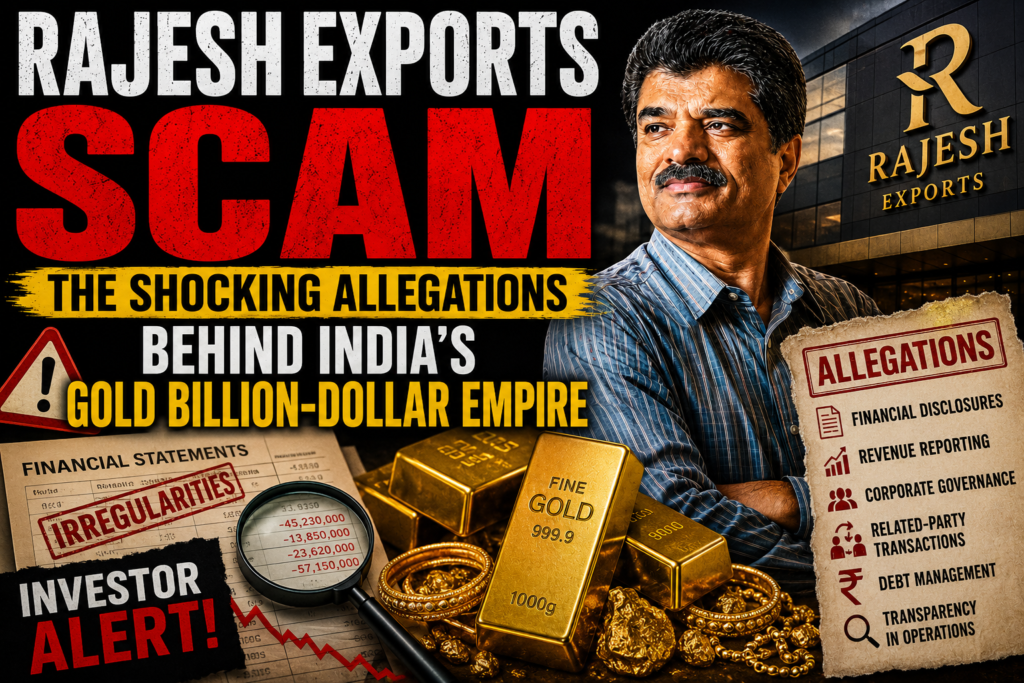
Several concerns reportedly focused on:
- Financial disclosures
- Revenue reporting
- Corporate governance practices
- Related-party transactions
- Debt management
- Transparency in operations
These issues became subjects of discussion among investors and financial experts.
Why Corporate Governance Matters

Corporate governance refers to the system through which companies are directed and controlled. Strong governance ensures that management acts in the best interests of shareholders and stakeholders.
When questions arise about governance standards, investors become concerned because:
- Investor Trust Can Decline
investors rely on financial statement to make informed decisions. If there are doubts regarding the accuracy of financial information, confidence can quickly erode.
2. Share Prices May Become Volatile
Market uncertainty often leads to significant fluctuations in stock prices. Even unverified allegations can trigger panic among retail investors.
3. Regulatory Attention Increases
Companies facing scrutiny may attract attention from regulators, stock exchanges, auditors and enforcement agencies.
4. Long-Term Reputation Suffers
A Company’s reputation one of its most valuable assets. Allegations of misconduct can take years to overcome, even if investigations ultimately clear the organization.
Impact on investors
One of the most significant consequences of any alleged corporate scam is its effects on shareholders.
Many retail investors invest their savings in listed companies with the expectation of long-term growth. When controversy emerges, investors often face uncertainty regarding:
- Future profitability
- Regulatory actions
- Management credibility
- Market performance
- Dividend prospects
This uncertainty can create anxiety among shareholders who may not have access to detailed information about the company’s operations.
Financial experts generally advise investors to avoid making emotional decisions during periods of market turbulence and instead focus on verified information and official disclosures.
The Role of Regulatory Authorities
In India, regulatory institutions play a crucial role in maintaining market integrity.
Organizations such as:
- Securities and Exchange Board of India(SEBI)
- Stock Exchanges
- Financial Auditors
- Enforcement Agencies
Are responsible for investigating potential violations and ensuring compliance with financial regulations.
When allegations arise against any listed company, these institutions may examine:
- Financial records
- Audit repots
- Transaction histories
- Corporate disclosures
- Compliance procedures
The objective is to determine whether any laws or regulations have been violated.
Lessons for Retail Investors
The Rajesh Exports controversy highlights several important lessons investors.
Diversification is Essential
One of the biggest mistakes investors make is concentrating their portfolio in a single stock.
Diversification helps reduce risk because losses in one investment can potentially be offset by gains in others.
Research Before Investing
Investors should carefully examine:
- Annual reports
- Quarterly results
- Debt levels
- Management track record
- Industry outlook
Conducting thorough research can help identify potential red flag before making investment decisions.
Avoid Following Market Rumors
Social media platforms often amplify speculation and misinformation.
Investors should rely on:
- Official company announcements
- Regulatory filings
- Verified news sources
- Professional financial analysis
rather than rumors circulating online.
Understand Business Fundamentals
A company’s long-term success depends on the strength of its business model, management quality and financial health.
Investors should focus on fundamentals rather than short-term market sentiment.
Media Coverage and public Reaction
News regarding the alleged Rajesh Exports scam generated widespread discussion across financial communities.
Some investors expressed concern about corporate transparency, while others urged caution until official investigations and findings became available.
Public reactions generally fell into two categories:
- Those demanding greater accountability and transparency.
- Those advocating that conclusions should only be drawn after verified evidence emerges
This divide is common in high-profile corporate controversies, Where information may evolve over time.
The Broader Impact on India’s Corporate Sector
Every major corporate controversy has implications beyond the company involved
Such incidents often lead to:
- Increased regulatory oversight
- Stronger disclosure requirements
- Improved auditing standards
- Greater investor awareness
- Enhanced corporate governance reforms
In the long run, these development can strengthen financial markets and improve investor protection.
India’s economy continues to attract domestic and international investment, making transparency and accountability increasing important.
Looking Ahead
The future of Rajesh Exports will depends on several factors, including regulatory finding, management responses, business performance and investor sentiment.
For investors, the situation serves as a reminder that no company is immune from scrutiny. Transparency, governance and ethical business practices remain essential components of sustainable corporate success.
As investigations and discussions continues, stakeholders will closely monitor developments to understand the full picture behind the allegations.
Conclusion
The Rajesh Exports scams controversy has become a significant topic within India’s financial and investment community. While allegations and concerns have raised important questions about corporate governance and transparency, it is essential to rely on verified facts rather than speculation.
The episode highlighting the important of strong regulatory oversight, responsible corporate management and informed investing. Whether the outcome ultimately confirms or dismisses concerns, the incident serves as a valuable lesson about the role pf accountability in modern business.
For investors, the key takeaway remains clear: conduct thorough research, diversify investments and make decisions based on credible information rather than market rumors. In an increasingly complex financial environment, knowledge and due diligence remain the best defenses against uncertainty.
1 thought on “Rajesh Exports Scam: The Shocking Allegations Behind India’s Gold Billion-Dollar Empire”